

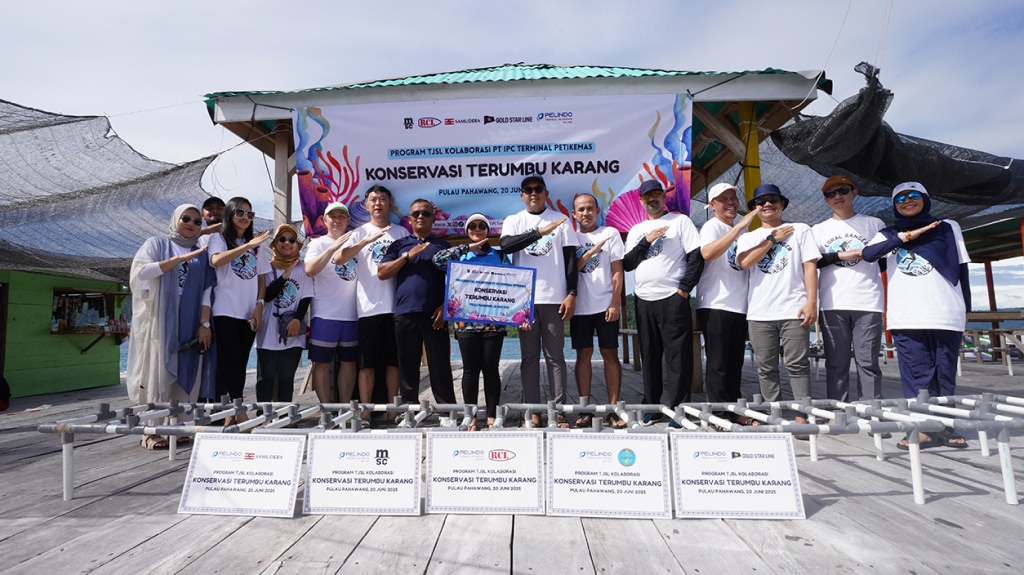
Bandar Lampung, June 24, 2025 – IPC Terminal Petikemas (IPC TPK), part of the Pelindo Terminal Petikemas Subholding, reaffirmed its strong commitment to sustainability and marine environmental conservation through its Social and Environmental Responsibility (TJSL) program. Together with four strategic partners—Mediterranean Shipping Company (MSC), Samudera Shipping Line (SSL), Gold Star Line (GSL), and Regional Container Line (RCL)—IPC TPK launched a coral reef restoration initiative in the waters of Pahawang Island, Lampung Province.
In collaboration with the local Lampung Underwater Community, the program successfully planted 25 reef racks containing 200 coral seedlings of the Acropora cervicornis species (staghorn coral)—a crucial coral type that supports marine biodiversity and protects coastlines from erosion.
“This marks our first TJSL program in partnership with Shipping Lines. As a maritime nation, Indonesia requires real synergy to protect its marine ecosystems. This coral planting is a small step with a big impact—not only for the environment, but also for local communities,” said Yanuar Evyanto, Acting Director of Commercial and Business Development at IPC TPK.
This initiative is not only an environmental effort, but also a part of IPC TPK’s Creating Shared Value (CSV) strategy—where business sustainability is intrinsically linked to tangible social and environmental contributions. The CSV approach promotes a shared vision: healthy oceans, sustainable business, and prosperous communities.
By preserving marine ecosystems, IPC TPK and its shipping line partners also support coastal economies by enhancing marine tourism potential and safeguarding natural resources vital to local livelihoods.
Ahmad Salim, Head of Pahawang Village, welcomed the program and expressed his appreciation for the involvement of the port and shipping sectors in ocean conservation. “Coral reefs are incredibly valuable to the people of Pahawang—both environmentally and economically. We thank IPC TPK and its partners for their contribution to protecting our seas,” he said.
A representative from Samudera Shipping Line, Dinar Hindarto, also praised IPC TPK’s conservation efforts. “This is a great initiative worth continuing and could serve as an inspiration for environmental stewardship. We hope this collaboration between IPC TPK and the shipping lines continues—especially here in the Lampung region,” he said.
Through this program, IPC TPK demonstrates that sustainability can be achieved not only through internal initiatives, but also through cross-sector collaboration. By engaging its service users—the shipping lines—IPC TPK strengthens strategic relationships while creating a lasting environmental legacy. Real collaboration leads to real impact.
“We hope this program is not the end, but the beginning of a long-term collaboration for a healthier Indonesian ocean and a more sustainable maritime future,” Yanuar concluded.