

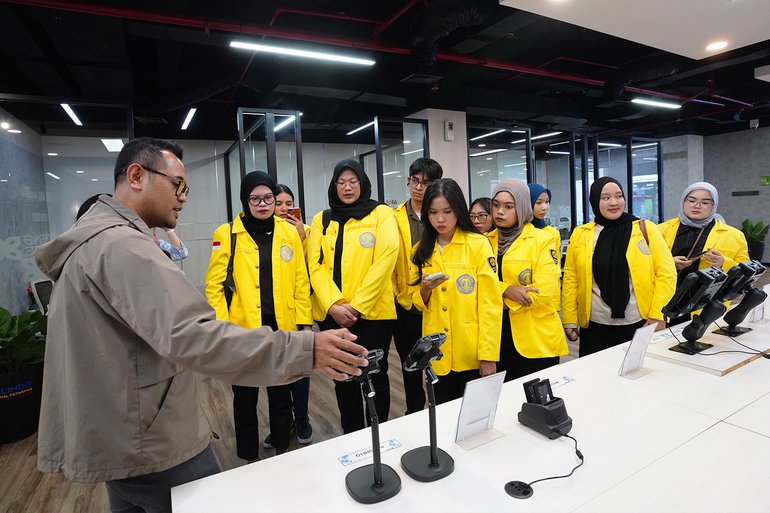
Jakarta, 13 May 2026 – Behind the loading and unloading activities, a port is the main hub of the national supply chain as well as a center of economic connectivity that opens up a great deal of room for various disciplines of knowledge and future talents. Departing from that spirit, IPC Container Terminal (IPC TPK) welcomed an industry visit from the Faculty of Economics and Business of the University of Indonesia as part of the Port Footprint Program (Jejak Pelabuhan) this past Friday (8/5).
The Port Footprint Program is an IPC TPK initiative to open access to industry learning while bridging academic theory with operational reality in the field. Through this program, students are introduced firsthand to the modern port ecosystem, which has now developed far beyond conventional operational activities.
During the visit, participants had the opportunity to see the modern logistics workflow firsthand by visiting the Integrated Planning & Control Room as well as Operations Terminal 3 at Tanjung Priok Port. Not only witnessing the container loading and unloading process, the students also gained an understanding of how a port serves as an important hub of the global supply chain, a center for business decision-making, and a part of the digital transformation and sustainability efforts within the national logistics industry.
On this visit, the students also delved deeper into the role of digitalization in modern port operations, from the use of integrated systems to support service efficiency to risk mitigation efforts against potential operational disruptions. In addition, the students gained an overview of customer relations management, the organizational structure within the port environment, and the importance of cross-sector and cross-functional coordination in ensuring the smooth flow of the loading and unloading process as an important part of the national supply chain.
The Corporate Secretary of IPC TPK, Daniel Setiawan, stated that this visit is part of the company’s commitment to broadening the horizons of the younger generation regarding the continuously developing port and logistics industry.
“The world of ports today is no longer an exclusive industry or one understood only by certain circles. This industry is very open and requires many scholarly perspectives, ranging from economics, business, technology, and data, to sustainability and communication. Therefore, we want to broaden horizons by showing that ports are an industry of the future that is relevant for the younger generation,” said Daniel.
Unlike academic visits in general, the Port Footprint Program is designed to provide a more contextual and strategic industry experience. Students are invited to understand how logistics efficiency affects national distribution costs, how international trade flows move through ports, and how container terminals are transforming through digitalization and the application of Environmental, Social, and Governance (ESG) principles.
As a container terminal operator under the auspices of the Pelindo Group, IPC TPK considers that early introduction to the industry is important in order to narrow the gap between the world of education and the needs of the industry. Open access to the world of ports is also expected to change the younger generation’s perspective that this sector is a dynamic, modern field with great prospects for the future.
“Through the Port Footprint Program, we want to present a learning experience that is closer to industry reality. Students not only see the operational process, but also understand how a port works as a connector of the supply chain and a driver of economic activity. The hope is that students can see firsthand that this sector continues to grow and requires many talents from a variety of scholarly backgrounds,” concluded Daniel Setiawan.