

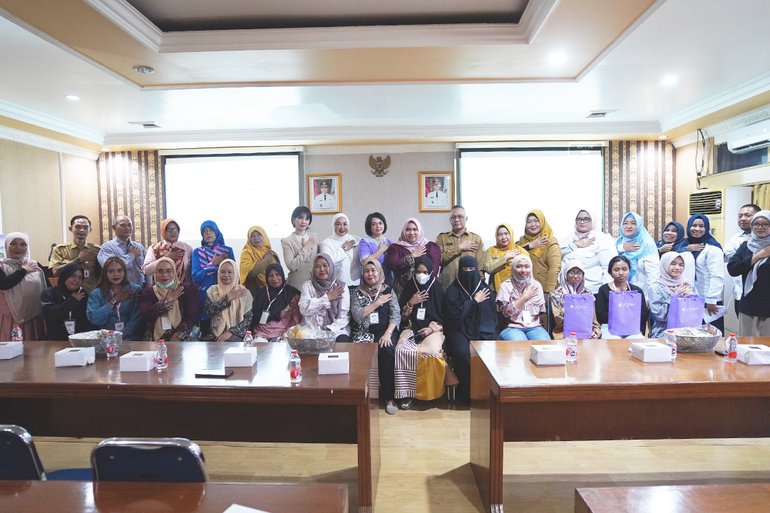
Pontianak, 12 May 2026 – IPC Container Terminal once again demonstrated its commitment to inclusive development through its Social and Environmental Responsibility (CSR) Program in the form of Facial and Body Care Skills Training for Women Therapists with Disabilities in West Kalimantan. This program, the result of a collaboration with the Indonesian Women with Disabilities Association (HWDI) of West Kalimantan and the Office of Cooperatives, Small and Medium Enterprises of West Kalimantan Province, represents a concrete step in opening access to skills and economic opportunities for women with disabilities.
Over the course of three days, 11–13 May 2026, a total of 20 women with disabilities took part in facial and massage skills training designed not only to enhance technical abilities, but also to build the participants’ self-confidence and economic independence. In addition to hands-on practice with professional trainers, participants also received guidance on customer service as well as the basics of entrepreneurship as provisions for entering the workforce or building their own independent businesses.
The Corporate Secretary of IPC Container Terminal, Daniel Setiawan, affirmed that the company’s CSR program is directed toward creating a sustainable social impact. “For us, CSR is not merely about providing assistance, but about opening opportunities and creating real change. Through this program, we want women with disabilities to have the space to grow, to create, and to be economically independent,” he said.
Support for the program was also expressed by the Head of the SME Empowerment Division of the Office of Cooperatives, Small and Medium Enterprises of West Kalimantan Province, Permai Budi Susatyo. According to him, this training is an important part of expanding access to economic empowerment for vulnerable groups. “We hope this activity can improve the participants’ competencies so that they become more empowered, independent, and able to meet the needs of their personal and family lives. Based on SIDT data for 2026, there are 338,257 MSME players in West Kalimantan and as many as 88,293 entrepreneurship players. This means that the opportunity to grow in the business sector is wide open, including for persons with disabilities,” he said.
For many women with disabilities, the greatest challenge often lies not in ability, but in the limitations of access and opportunity. For this reason, the program is designed as a space for learning and a space for growth that brings together the company, the disability community, local government, professional trainers, and local business partners to jointly open up wider opportunities for women with disabilities.
The Chairwoman of HWDI West Kalimantan, Linda Fardini, expressed her appreciation for the initiative presented by IPC Container Terminal. “Women with disabilities must also have the same opportunity to be independent and to develop. We hope the skills gained by the participants can become a real provision for them to do business and improve their quality of life. Thank you to IPC Container Terminal for the care and support given to women with disabilities in West Kalimantan,” she said.
This program is part of IPC Container Terminal’s ongoing commitment to delivering social impact through a “from skill to sustainability” approach, namely an empowerment process that begins with the mastery of basic skills, hands-on practice, and continues through to opening access to business development opportunities in the future.
The initiative is also in line with the company’s support for the 4th Asta Cita of the Government of the Republic of Indonesia in strengthening human resource development through the empowerment of women and persons with disabilities. In addition, this program contributes to the achievement of the Sustainable Development Goals (SDGs), particularly Gender Equality (SDG 5), Decent Work and Economic Growth (SDG 8), and Reduced Inequalities (SDG 10).
Through this program, IPC Container Terminal believes that inclusion does not stop at rhetoric, but must be realized through real access, skills, and opportunities so that every individual has an equal chance to develop and become independent.