

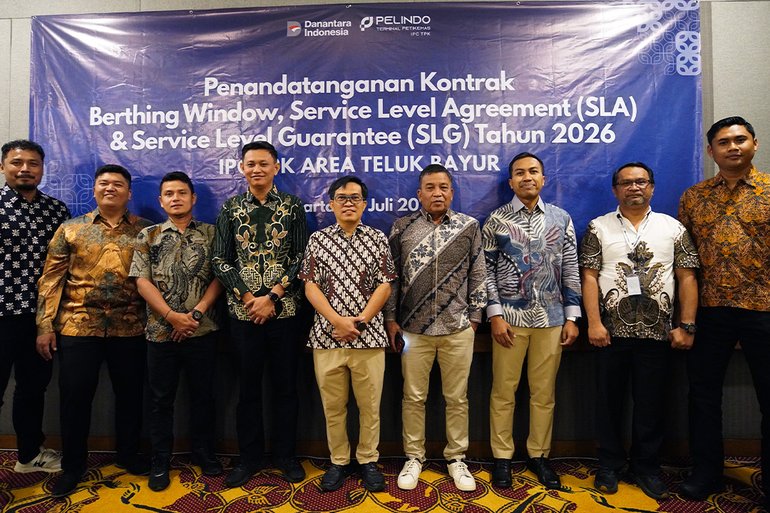
Jakarta, July 24, 2026 – IPC Terminal Petikemas (IPC TPK) continues to strengthen its commitment to improving the efficiency and reliability of maritime logistics services, particularly in West Sumatra. This commitment was demonstrated through the signing of the 2026 Berthing Window, Service Level Agreement (SLA), and Service Level Guarantee (SLG) contracts for IPC TPK Teluk Bayur. The strategic signing ceremony was held in Jakarta on Thursday (July 23) with four key customers: PT Meratus Line, PT Tanto Intim Line, PT Salam Pacific Indonesia Lines (SPIL), and PT Temas Shipping.
Director of Operations & Engineering of IPC TPK, Ahmad Mimbar, stated that this collaboration represents a concrete step by the company to provide greater service certainty and operational excellence for its strategic customers.
“The signing of the Berthing Window, SLA, and SLG agreements reflects our commitment to strengthening the partnership between the terminal operator and our customers, ultimately ensuring that we consistently meet their service expectations,” said Ahmad Mimbar.
The signing ceremony was witnessed and attended by Ferrial Dunan Sidabutar, General Manager of Pelindo Regional 2 Teluk Bayur. IPC TPK Teluk Bayur was represented by Andreas Kusumah Wardhana Tuelah, Manager of Operations Support. This collaboration is expected to optimize cargo handling productivity while providing greater operational certainty for container vessels calling at West Sumatra.
As one of the main gateway ports on the west coast of Sumatra, Teluk Bayur Container Terminal plays a vital role in supporting regional and national trade flows through continuous improvements in operational performance. With the implementation of the new SLA and SLG commitments, IPC TPK aims to deliver transparent and accountable services. The four participating shipping companies are expected to benefit from improved operational efficiency, supported by the terminal’s reliable infrastructure and superstructure.
“We hope today’s signing will contribute to smoother operations and enhance terminal productivity, making our services more efficient and optimal,” Ahmad concluded.