

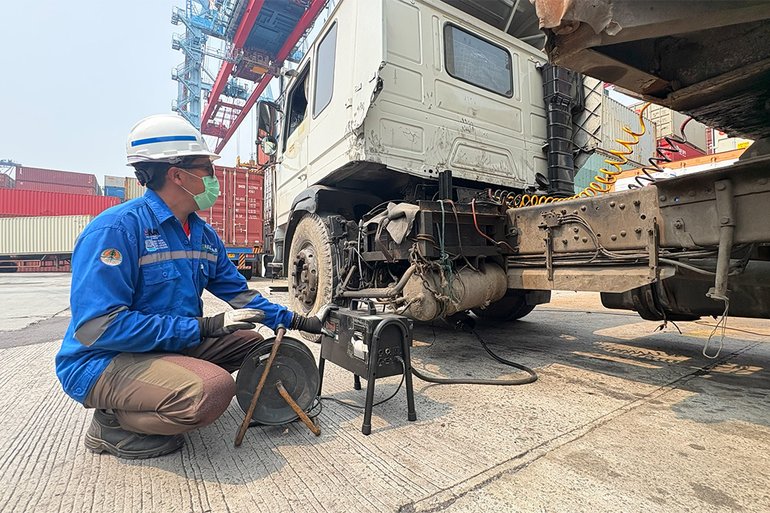
Jakarta, July 9, 2026 – Demonstrating its commitment to environmental sustainability and the implementation of Environmental, Social, and Governance (ESG) principles, PT IPC Terminal Petikemas (IPC TPK) organized a Corporate Social and Environmental Responsibility (TJSL) program by providing free vehicle emission testing at Tanjung Priok Port. Held on July 6–7, 2026, the program targeted external container trucks that operate intensively within the port area. The initiative formed part of IPC TPK’s 13th Anniversary celebrations while reaffirming the company’s commitment to supporting United Nations Sustainable Development Goal (SDG) 13: Climate Action.
Daniel Setiawan, Senior Manager of Corporate Secretariat at IPC TPK, said the program represents a concrete effort by the company to reduce air pollution within the port environment.
“Through this emission testing program, we aim to ensure that container trucks operating within IPC TPK’s operational areas comply with the government’s vehicle emission standards. As we celebrate our 13th anniversary, IPC TPK remains committed not only to ensuring the smooth flow of national logistics but also to actively contributing to cleaner air and environmental sustainability,” Daniel said.
To maximize participation and ensure convenient access for customers and other stakeholders within the port ecosystem, IPC TPK conducted the emission testing at three strategic locations across Tanjung Priok Port: Tanjung Priok Area 1 Zone 1, Tanjung Priok Area 1 Zone 3, and Tanjung Priok Area 2 International. These locations were selected due to the high volume of container truck traffic passing through the terminals each day.
Over the two-day program, IPC TPK successfully conducted emission tests on 216 container trucks. A total of 201 trucks, representing a 93 percent pass rate, met the required vehicle emission standards.
“Going forward, IPC TPK will continue to introduce innovative TJSL programs that generate tangible environmental benefits and contribute to preserving the planet for future generations,” Daniel concluded.