

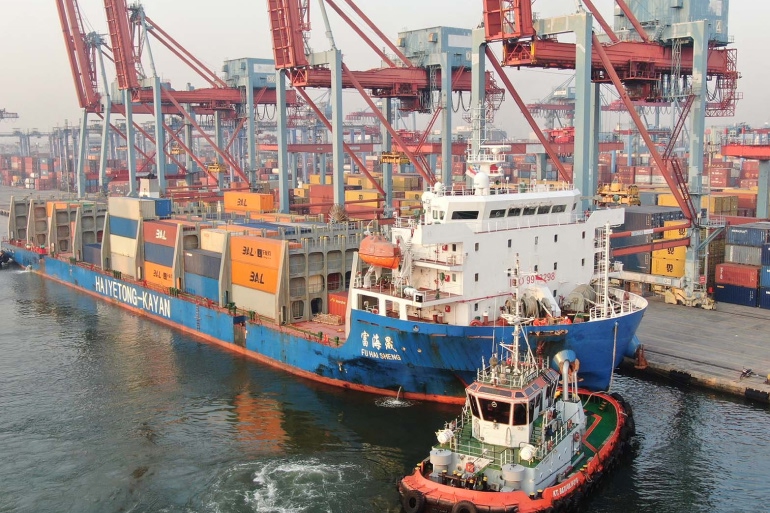
Jakarta, October 10, 2025 – IPC Terminal Petikemas (IPC TPK), a subsidiary of Pelindo Terminal Petikemas, has resumed its Adhoc Service in collaboration with OVP Shipping and its shipping agent KCA Global Maritim. This service was marked by the docking of MV Fu Hai Sheng at IPC TPK’s Terminal 3 in Tanjung Priok, with its final destination being China. The service is expected to open new opportunities and boost trade between Indonesia and China.
“We warmly welcome the new service from OVP Shipping. The arrival of MV Fu Hai Sheng is not just a new route, but a tangible sign of strengthening maritime connectivity between Indonesia and China. IPC TPK is committed to providing optimal terminal services for every shipping partner. Through collaborations like this, we aim to contribute to enhancing the competitiveness of national trade,” said Pramestie Wulandary, Corporate Secretary of IPC TPK.
MV Fu Hai Sheng has a Length Overall of 141 meters and a Beam of 28 meters. The China-flagged vessel completed loading and unloading operations totaling 275 boxes. It docked on Thursday, October 9, 2025, at 06:00 WIB and departed for Port Klang, Malaysia, the same day at 17:00 WIB. The planned route for the vessel is Jakarta – Port Klang – Qingdao.
Throughout 2025, IPC TPK has served six new shipping services to various destinations. The first service of the year was the ARX Service by Marsa Ocean Shipping with a direct call to Djibouti. In February, Meratus Line launched a new service with additional vessels to support the PNG Service direct call to Papua New Guinea. In April, IPC TPK handled KM HT Progress from FIAS Shipping with destinations to Bangkok and Ho Chi Minh City. In May, Sukses Sindo Damai Shipping introduced additional services to Singapore via Pontianak and Panjang. In September, MV Alvan opened a new route to Vietnam, launched by HDAS CO with Karana Line as the agent.
According to Indonesia’s Central Bureau of Statistics (BPS) via Antara, exports to China rose by 8.9%, reaching USD 30.5 billion from January to June 2025. This increase was driven primarily by exports of nickel and its derivatives, such as iron and steel, as well as agricultural and plantation commodities. Export values of several agricultural products also surged, including rubber (up 182%), coffee (up 90%), cocoa (up 88%), and fruits (up 10%). Meanwhile, imports from China also grew by 21%, totaling USD 40.2 billion, mainly consisting of vehicles, electronic equipment, and technical machinery. This indicates a growing trade potential between Indonesia and China year over year.
“Synergy between terminal operators and shipping lines is key to building an efficient supply chain. We believe this service is a concrete step toward boosting Indonesia’s export growth,” Pramestie concluded.