

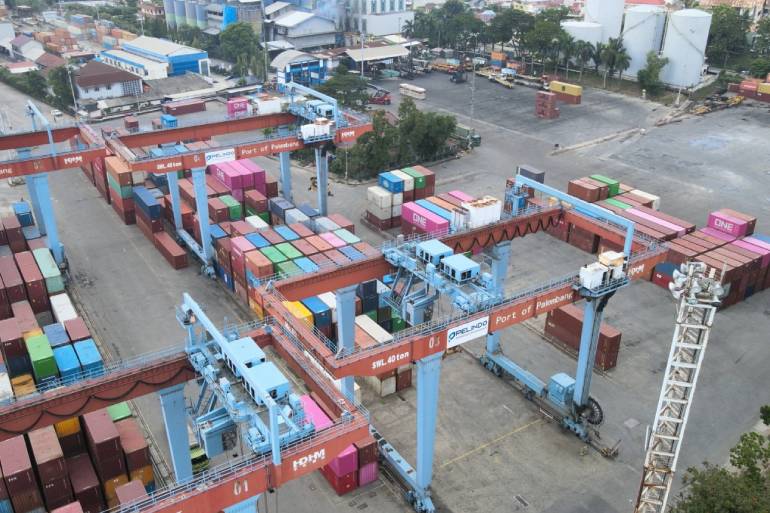
Palembang, 28 January 2026 – IPC Terminal Petikemas (IPC TPK) recorded positive performance at its Palembang Area throughout 2025. Performance continued to grow despite sluggish export–import conditions in South Sumatra Province. IPC TPK remained focused on strengthening its services while navigating global trade challenges during several periods.
“This positive performance reflects the strong synergy between IPC TPK and stakeholders in South Sumatra in facing global challenges,” said Agustian Chandra, Manager of IPC TPK Palembang Area.
The performance of IPC TPK Palembang in 2025 showed a positive upward trend of 6.15% compared to the previous year. Container throughput in 2025 reached 121,422 TEUs, higher than the 2024 realization of 114,383 TEUs. The Palembang Container Terminal continued to grow amid economic fluctuations in South Sumatra.
This growth was driven by several factors, including improved vessel connectivity and the consolidation of export–import commodities transported through Palembang Port. The increase included the handling of imported factory spare parts and rising rubber exports throughout the third and fourth quarters of 2025. In addition, imports conducted by PT Kereta Api Indonesia (PT KAI) contributed approximately 700 TEUs to throughput during the second half of 2025. Growth was also supported by the diversion of rubber commodity cargo from Belawan to Palembang.
Meanwhile, South Sumatra’s foreign trade performance experienced pressure through November 2025. Export value declined by 3.80%, while imports dropped sharply by 51.64% compared to the same period in the previous year. Based on data from Statistics Indonesia (BPS) of South Sumatra, export value from January to November 2025 reached US$5.82 million, down from US$6.05 million in the same period of 2024. The decline was mainly driven by weaker oil and gas exports, which fell by 16.24%, as well as a 2.8% correction in non-oil and gas exports.
“IPC TPK continues to improve service efficiency, accelerate export–import container handling, and expand sea-route connectivity to strengthen the logistics network in Sumatra,” Agustian concluded.