

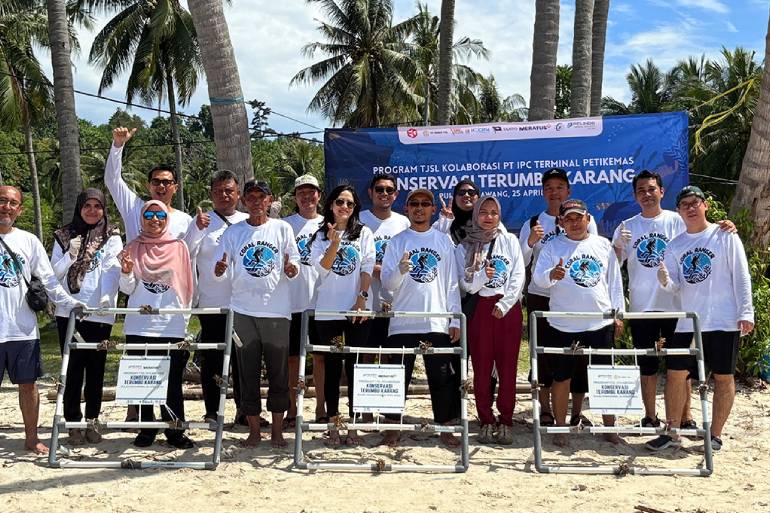
Bandar Lampung, April 27, 2026 – IPC Terminal Petikemas (IPC TPK) has reinforced its sustainability commitment by conducting a Corporate Social and Environmental Responsibility (TJSL) program through coral reef planting in the waters of Pahawang Island, Lampung, on Saturday (April 25). This activity was particularly significant as it involved cross-sector collaboration with six strategic partners from shipping line companies: Caraka Tirta Perkasa (CTP), Meratus Line, Indo Container Line, Temas Line, Salam Pacific Indonesia Lines (SPIL), and Tresna Muda Sejati.
This initiative marks the second coral reef planting activity carried out by IPC TPK together with its customers, reflecting the company’s sustainable approach that extends beyond internal operations to actively engage the entire port ecosystem. Through this collaboration, IPC TPK encourages stakeholders—particularly shipping service users—to take part in preserving marine ecosystems as a foundation for the sustainability of the maritime industry.
“This conservation program is a concrete step by IPC TPK in conducting business aligned with sustainable principles. Marine preservation is a shared responsibility, especially for those of us in the maritime sector. By involving six major shipping lines, we aim to build collective awareness that advancements in logistics operations must go hand in hand with environmental restoration,” said Yanuar Evyanto, Acting Director of Commercial & Business Development of IPC TPK.
This initiative also underscores IPC TPK’s consistent commitment to marine ecosystem preservation. Since 2017, IPC TPK has continuously implemented various coral planting and rehabilitation activities in several coastal areas as part of its long-term environmental commitment.
In this activity, a total of 35 planting racks with 280 coral seedlings were deployed and installed on the seabed in the waters of Pahawang Island. The location was selected due to its high biodiversity potential, although it requires rehabilitation due to the impacts of climate change and human activities. The coral planting is expected to accelerate reef recovery, which will serve as a habitat for fish, protect coastlines, and enhance ecotourism potential—ultimately supporting the economic growth of coastal communities in Lampung.
Healthy coral reefs also provide indirect benefits to the sustainability of port ecosystems. They play a vital role in maintaining marine biodiversity and water quality, which in turn supports environmental stability around the port. Well-maintained waters help minimize excessive sedimentation and preserve navigation channel depth, allowing loading and unloading activities to run more smoothly, safely, and efficiently.
According to data from the International Coral Reef Initiative (ICRI), from January 2023 to March 2025, bleaching levels have contributed to damage in 84% of the world’s coral reefs due to heat stress. This period marks the highest level of global coral reef degradation, with more than 80% indicating coral mortality.
The active participation of Caraka Tirta Perkasa (CTP), Meratus Line, Indo Container Line, Temas Line, Salam Pacific Indonesia Lines (SPIL), and Tresna Muda Sejati in this initiative demonstrates strong stakeholder alignment within the port in supporting the Sustainable Development Goals (SDGs), particularly in marine ecosystems. During the planting process, IPC TPK also collaborated with the Lampung Underwater Community to provide education on the importance of protecting coral structures from physical damage.
“We would like to thank IPC TPK for its efforts in preserving natural ecosystems for future generations. Today’s activity is remarkable and has strengthened our relationship as a shipping line with IPC TPK,” said Ketut Bambang from Meratus Line.
This synergy proves that the relationship between terminal operators and shipping lines goes beyond operational efficiency in cargo handling, extending to environmental sustainability that delivers long-term benefits for both the industry and society.
“Through this initiative, IPC TPK aims to ensure that every operational step leaves a positive impact on nature. We are committed to continuously monitoring the growth of these coral seedlings to ensure long-term benefits. We hope this initiative will inspire more stakeholders in the logistics industry to actively contribute to preserving Indonesia’s maritime wealth for future generations,” Yanuar concluded.