

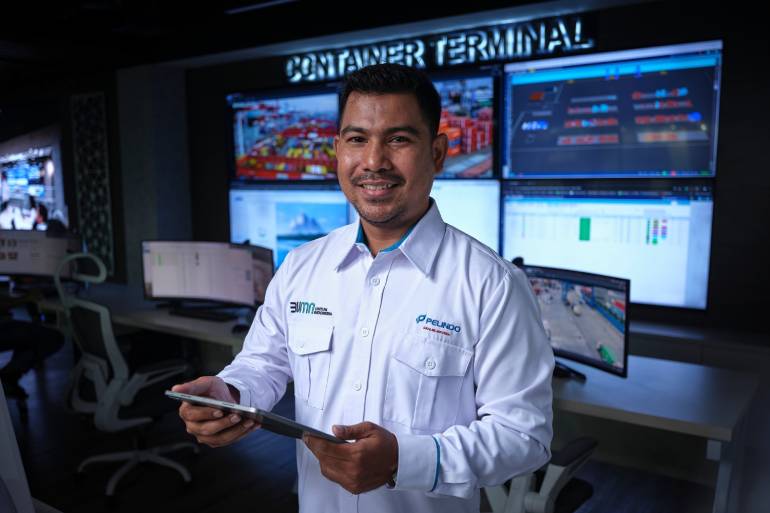
Jakarta, 19 January 2026 – IPC Terminal Petikemas (IPC TPK) has established its 2026 corporate theme, “Operational and Service Excellence,” as the initial step in implementing the IPC TPK Roadmap under the Company’s Long-Term Plan (RJPP) 2026–2030. This determination reflects the company’s commitment to improving port service quality, strengthening logistics connectivity, ensuring sustainable business growth, and delivering broader benefits to society and the national economy.
The IPC TPK Roadmap 2026–2030 is structured into three development phases: Operational & Service Excellence, Business & Connectivity Enhancement, and Sustainable Development. These phases are designed to address stakeholders’ needs for reliable, integrated, and competitive container terminal services amid the dynamic global logistics industry.
In the first phase, Operational & Service Excellence, IPC TPK focuses on strengthening operational performance and service quality as its primary foundation. This initiative is aimed at ensuring more efficient, safe, and consistent loading and unloading processes, thereby providing service certainty for customers, logistics players, and business partners.
To support this strengthening, IPC TPK continues to implement terminal operation standardization, systemization, and integration programs, while accelerating service digitalization initiatives that began in the previous year. These efforts are intended to enhance transparency, service speed, and ease of information access for customers, while improving logistics cost efficiency and reinforcing user trust. In 2026, these initiatives represent a continuation of the digital transformation programs implemented throughout 2025.
The programs include the implementation of the Terminal Booking System (TBS) to improve vehicle flow management and terminal services, the deployment of container scanning equipment to strengthen security and compliance aspects, as well as the implementation of the Nusantara Terminal Operating System (TOS) through two flagship systems, PARAMA and PRAYA. These systems serve as the backbone of standardized, integrated, and data-driven terminal operations.
In addition to operational strengthening, IPC TPK is also restructuring its business model to reinforce its role as a container terminal operator within the Pelindo Terminal Petikemas Subholding (SPTP). This restructuring aims to establish a healthy, competitive business structure capable of delivering added value to shareholders.
As part of its medium-term development, IPC TPK has begun initiating plans for the hub and spoke concept across its managed terminals. This concept is intended to enhance inter-terminal connectivity, optimize capacity utilization, and support the creation of more competitive service costs. Implementation will be carried out gradually, taking into account infrastructure readiness, system integration, and service volumes.
President Director of IPC Terminal Petikemas, Guna Mulyana, stated that the roadmap and the 2026 corporate theme were formulated to ensure sustainable and healthy company growth. “Strengthening operations and services is a fundamental necessity for IPC TPK to deliver optimal value to customers, society, and shareholders, while reinforcing the role of ports in supporting national logistics flows,” he said.
As an illustration of service readiness, during the transition from 2025 to 2026 IPC TPK continued to handle seven vessels marking the final services of 2025 and seven vessels representing the first services of 2026 across various operational areas. This activity reflects IPC TPK’s commitment to maintaining uninterrupted port services, including during year-end transition periods.
Through the establishment of the 2026 corporate theme and the RJPP Roadmap 2026–2030, IPC Terminal Petikemas remains optimistic about continuously improving container terminal service quality, strengthening logistics connectivity, and delivering tangible contributions to economic growth and public welfare.