

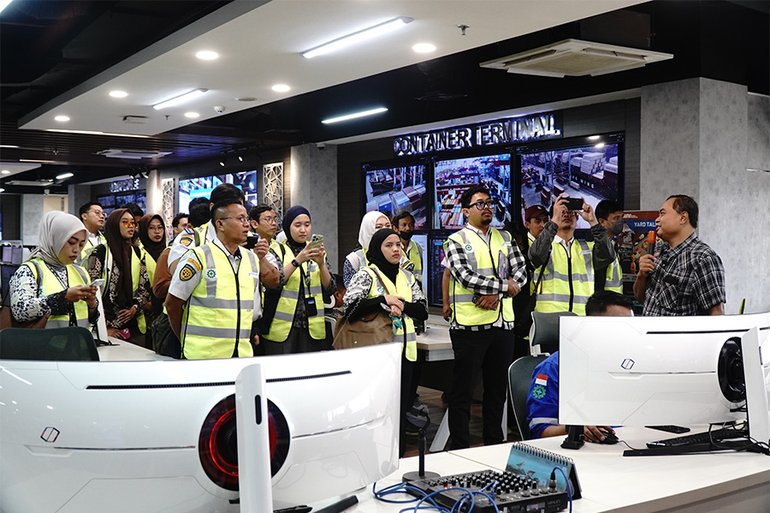
Jakarta, August 26, 2026 – IPC Terminal Petikemas (IPC TPK) hosted a field visit by the National Development Planning Agency of the Republic of Indonesia (Bappenas RI) at Tanjung Priok Port, Jakarta. The strategic visit was conducted as part of the Strategic Coordination for Regional Connectivity Development to Increase Added Value in the Western Indonesia Development Region in DKI Jakarta Province.
Held at the Integrated Planning & Control center, the visit aimed to provide an overview of the actual conditions of container loading and unloading operations, identify various challenges and development opportunities, and gather direct input from stakeholders to ensure that the formulation of national logistics policies is well-targeted and aligned with conditions and needs on the ground.
“We warmly welcome and appreciate the visit of the Bappenas RI delegation to IPC TPK’s Integrated Planning & Control center. Through digitalization and real-time system monitoring, IPC TPK continues to remain committed to improving operational efficiency and the reliability of loading and unloading services. Collaboration with Bappenas is crucial to ensuring that national infrastructure and connectivity planning remains aligned with operational dynamics in the field,” said Daniel Setiawan, Senior Manager of Corporate Secretary.
During the visit, the Bappenas RI team received a comprehensive presentation on cargo flows, terminal productivity levels, and the integration of port digitalization systems, which serve as the backbone of smooth logistics flows in Western Indonesia. The interactive discussion focused on mapping connectivity links between maritime and land-based nodes, optimizing terminal capacity, and developing strategies to reduce national logistics costs. Fact-based operational data presented during the session served as an important reference for Bappenas in precisely assessing and mapping regional development potential.
The field visit served as a productive platform for collaboration between national policymakers and terminal operators as the frontline of the maritime logistics system. A deeper understanding of the actual conditions at container terminals in DKI Jakarta is expected to strengthen the foundation for the formulation of government priority programs aimed at increasing the economic added value of the Western Indonesia region.
A well-integrated connectivity network is considered a key factor in enhancing the competitiveness of national products, improving cargo flow efficiency, and promoting more equitable economic growth across regions in Indonesia.
“IPC TPK is ready to actively contribute factual data and constructive input to Bappenas RI. We are optimistic that the results of this field visit and strategic coordination will generate policy recommendations that strengthen maritime connectivity, optimize the added value of the Western Indonesia region, and create an increasingly efficient, reliable, and highly competitive national logistics ecosystem,” concluded Daniel.